
Work lives in too many places
Client details in one sheet, jobs in another, files in chat threads and e-mail.
Custom business software
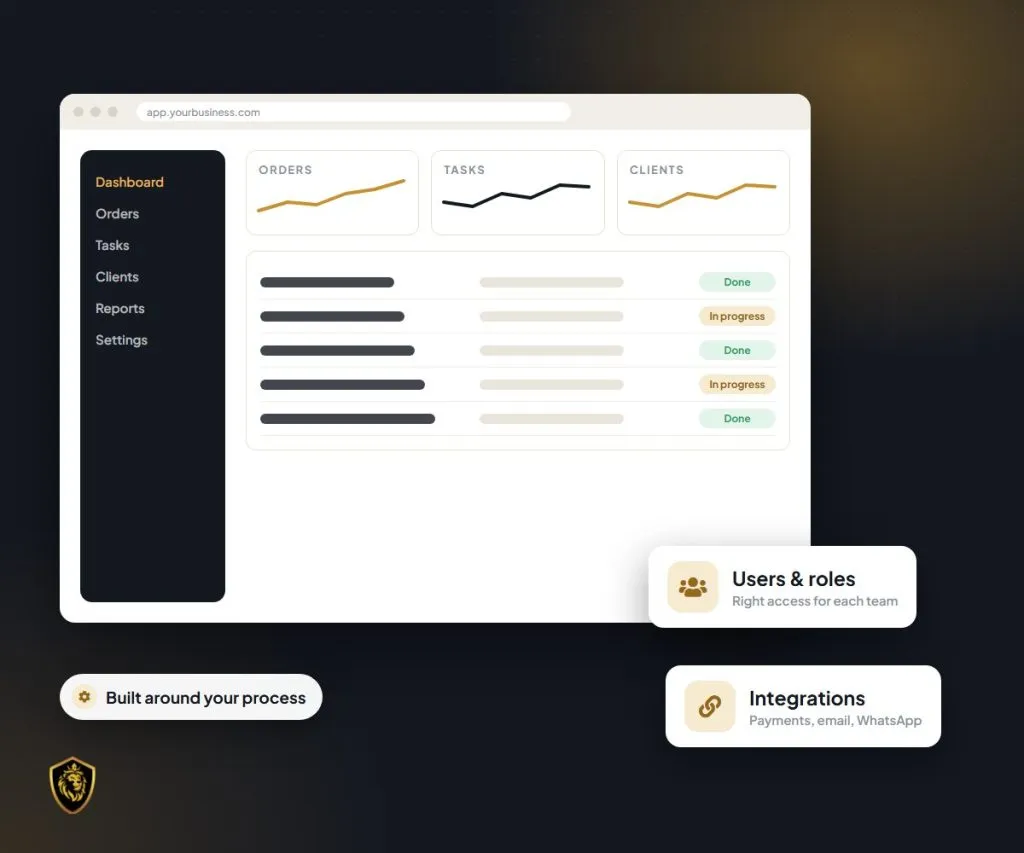
Spreadsheets and off-the-shelf tools are a sensible start. But as the business grows, work ends up spread across sheets, WhatsApp groups and tools that don’t talk to each other, and nobody has the full picture. We build internal software around how your team actually works: CRMs, client portals, dashboards and integrations.
At a glance
Where you are now
How we do it
What you get
Does this sound familiar?

The business works, but it works because people remember things, chase each other and copy information from one place to another. It held together when the team was small. Now every new client, job or employee adds a little more friction.
If any of the following sounds familiar, you are in good company:
Client details in one sheet, jobs in another, files in chat threads and e-mail.
Information is re-entered between tools, and mistakes creep in.
Answering “where does this job stand?” means asking around or opening several files.
The software you pay for forces awkward workarounds, or covers only part of the process.
Everyone can see and edit everything, or sensitive information is shared by forwarding files.
Monthly figures mean exporting, merging and fixing spreadsheets by hand.
Most growing businesses reach this point. The process has outgrown the tools: each tool solves one piece, and people fill the gaps by hand.
These are patterns business owners often describe to us. They are not a verdict on your systems; that needs a proper look at how you work.
The real cost
The cost is spread across the day, which is why it is easy to underestimate.

Hours go on copying, checking and chasing instead of the work customers pay for.
A missed follow-up, a wrong price or a lost file damages confidence in the business.
Without reliable figures, it is hard to know which work, clients or people are performing well.
Each new client or team member makes the workarounds harder to keep up.
Why it happens
Each is understandable, and each can be avoided with a little planning.
01
Custom software can feel like the obvious answer to a frustrating process.
Better: Check off-the-shelf tools first. Build only where your process is a real advantage or existing tools force awkward workarounds.
02
Demos are persuasive, and the process seems obvious.
Better: Map how work actually flows, who does what and what data is needed, then judge tools against it.
03
It is tempting to fix every problem in one project.
Better: Start with the part that causes the most friction, launch it, and add the rest in stages.
04
Decisions are often made by managers alone.
Better: Involve the people who will use the system in discovery and testing, and plan the move from old sheets and tools.
05
Access rules and data import are left until the end.
Better: Decide early who can see and change what, and plan how existing data will be imported and checked.
What good looks like
Good internal software disappears into the day: people use it because it makes their work easier.
Before
Without a clear plan
After
With The Lion Kingdom
Software supports a process; it can’t fix one nobody has agreed on. We help you define the process first.
How we help
When spreadsheets and off-the-shelf tools stop fitting the way your team works, we build internal software around your processes: CRMs, client portals, dashboards and integrations.

We map the process with your team before anything is built.
Who does what, who sees what, and which data the system must hold.
A review of your current tools and how they could connect.
An internal system, CRM, dashboard or client portal built for your process.
Separate access for staff and clients, so each sees only what they should.
Connections to the tools you keep, where they offer an API or export.
Existing records imported from current sheets or tools and checked.
Team walkthroughs and written documentation for day-to-day use.
A plan for support and improvements once the system is in use.
Typical scope. The exact deliverables are agreed in your written proposal, and not every item is part of every engagement. Often built on WordPress with custom plugins, or on another stack where it suits better. Agreed in the proposal.
Why work with us
The Lion Kingdom was founded in Nagpur in October 2021 by Pavan Khobragade, who leads the business.
Scope, timeline, cost and payment terms are agreed in a written proposal before work starts.
Once the agreed project fees are paid, you own the deliverables created specifically for your project. Pre-existing tools and third-party software keep their own terms, as set out in your project agreement.
You see progress regularly and can change priorities between stages.
Who it is for

If custom software isn’t the right next step, we will say so and suggest an existing tool or a simpler fix.
How we work
01
We learn how work flows today, where it gets stuck and who is involved.
02
We map roles, data and integrations, and agree what to build first.
03
We build the first part of the system and share it for review with the people who will use it.
04
We import existing data, test with real examples and walk your team through it.
05
We fix issues, gather feedback and plan the next improvements with you.
The exact steps depend on your starting point and the agreed scope, and are set out in your proposal.
FAQ

Often you should, and we will say so. Custom software makes sense when your process is a competitive advantage or existing tools force awkward workarounds.
Usually, if those tools offer an API or export. We check this during discovery.
Access is set by role, so staff and clients only see what they are allowed to see.
Once the agreed project fees are paid, you own the deliverables created specifically for your project, such as its custom code and designs. Tools and components we built before your project, and reuse across client work, are not transferred to you. Open-source and third-party software keeps its own licence. Your signed project agreement sets out the final ownership terms.
Both depend on the scope. After discovery we give you a written proposal with the scope, timeline and cost for the first stage, rather than a generic estimate.
A process owner on your side, access to the tools and data to be replaced or connected, and time from the people who will use the system.
We agree a support and improvement plan with you, so the system keeps up as the business changes.
Related services
From idea to a working software product your customers sign up for: discovery, MVP and steady iteration.
Every enquiry captured, assigned and followed up on time by WhatsApp or e-mail, with consent respected.
Repeated tasks connected and automated between the tools you already use.
Book a free 30-minute introductory strategy call to talk through how your team works and where software could help, or whether an existing tool would do. We are a founder-led team in Nagpur, and we agree the scope in writing before any work starts.